
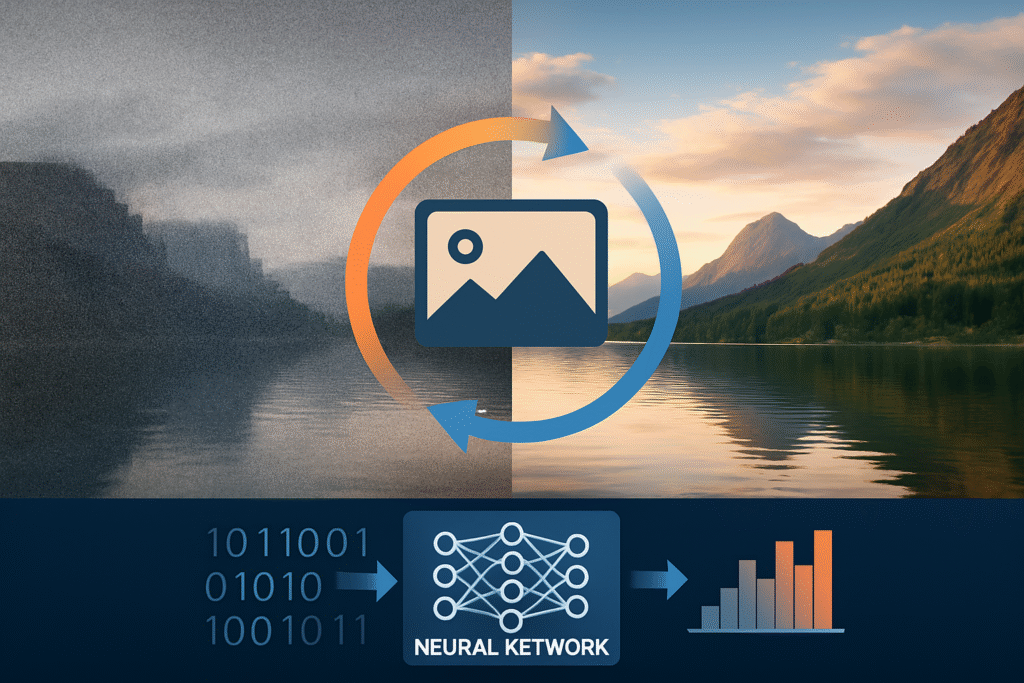
Why Image Restoration Is Essential in 2025
In 2025, we live in a world where so much depends on visuals, whether it’s a doctor looking at a scan, a satellite sending images back to Earth, or someone trying to restore an old photograph. When those images aren’t clear, the outcome suffers.
That’s why image restoration in digital image processing has become so important. We’re not just talking about improving photos for fun. We’re talking about critical applications in healthcare, security, agriculture, and beyond, where sharp, usable visuals are essential.
What is Digital Image Processing?
Digital image processing is the process of improving digital images using computers. It’s used to clean up, sharpen, and enhance images so they can be used more effectively.
In simple terms, it’s about taking an imperfect image and making it clearer or more meaningful.
A basic image processing system usually includes:
- A device that captures the image (camera, scanner, etc.)
- Software or hardware that processes the image
- Algorithms that detect what’s wrong and fix it
- And something to display or save the result, like a screen or file
As more industries rely on images to work smarter and faster, the ability to process and restore them has become a vital part of modern operations.
What Causes Images to Lose Quality?
Before you can fix an image, it helps to know why it went wrong in the first place. Some of the most common reasons include:
- Motion blur from shaky hands or moving subjects
- Sensor noise, especially in low light
- Over-compression, which is common in JPEG files
- Scratches or missing areas in scanned or old photos
- Dust, fog, or poor lighting during capture
- Data loss during transfer, often seen in satellite or medical imaging
These problems can make an image less useful — or even unusable — until it’s properly restored.
Core Image Processing Techniques for Restoration
There’s no single tool that works for every situation. Instead, professionals use a combination of image processing techniques, depending on what needs fixing.
1. Reducing Noise with Filters
When an image is full of grain or visual distortion, filters are used to clean it up. Common ones include:
- Gaussian filter – softens the image to reduce noise
- Median filter – removes random speckles
- Wiener filter – balances sharpness and noise removal
- Adaptive filters – adjust depending on what’s in the image
These filters are key image enhancement techniques in digital image processing and are used almost everywhere.
2. Fixing Blur
If a photo is blurry, tools like inverse filtering, Wiener deconvolution, and blind deconvolution can help bring the sharpness back. These are especially useful for restoring details in images affected by camera shake or soft focus.
3. Frequency-Based Methods
Some techniques look at the image in terms of frequency, focusing on the patterns instead of pixels. These are great for technical work, like analyzing scientific or satellite imagery, where structure matters more than color.
4. Model-Based Restoration
In areas like medical imaging, model-based restoration is used. This means building a mathematical model of how the image was damaged, then reversing it. It’s detailed, precise, and effective when accuracy matters.
AI and Deep Learning Trends in Image Restoration (2025)
In recent years, technology has taken a huge leap forward. Today, deep learning and smart software can now do what used to take hours — and do it better.
One major development is the use of Generative Adversarial Networks (GANs). These systems learn from thousands of images and can now:
- Fill in the missing parts
- Sharpen blurred photos
- Improve low-resolution images
- Remove noise with minimal detail loss
Modern smartphones already use this kind of image processing software. You don’t even notice it — but the moment you take a low-light photo, the phone cleans it up before you even see it.
Where Image Restoration Is Making the Biggest Impact in 2025
Healthcare
Doctors use image restoration to get better results from MRI or CT scans. It helps speed up diagnosis and reduces the need for repeat scans, saving time and avoiding extra exposure for patients.
Satellite and Remote Imaging
Agriculture, disaster relief, and environmental monitoring all rely on clean satellite images. Restoration tools help fix the distortions caused by clouds, dust, or broken data.
Security and Law Enforcement
Footage from surveillance cameras is often of poor quality. Restoring those images can reveal vital information — faces, license plates, or events that would otherwise be missed.
Old Photo Restoration
Tools like Photoshop and Topaz Labs make it possible to fix old, faded, or damaged pictures, helping families and museums preserve memories that would otherwise fade away.
Role of Feature Extraction in Image Restoration
When you restore an image, you want to fix the damage, but you don’t want to erase important details. That’s where feature extraction in image processing comes in.
This method helps the system recognize important parts of the image — like edges, lines, or textures — and makes sure they stay intact during restoration. It’s especially important in things like facial recognition, medical scans, and aerial photography.
Choosing the Right Image Processing Software in 2025
Depending on your goals, there are different tools available for restoring images. Here are some that people trust in 2025:
- OpenCV – Ideal for developers building custom solutions
- MATLAB – Common in academic and research environments
- Topaz Labs – Excellent for restoring photos with the help of AI
- Adobe Photoshop – Still one of the best for professionals and creatives
The right image processing software will depend on what you’re restoring, how technical the work is, and how much control you need.
We depend on images more than ever — in our work, our memories, and our decision-making. But not every image comes out right. Whether it’s noise, blur, damage, or lost data, digital image processing offers real solutions.
And in 2025, thanks to a mix of classic techniques and smart new tools, we can restore visuals that once seemed impossible to fix.
Need Help Restoring Images That Matter?
At YNV Technologies, we help teams across healthcare, security, research, and heritage restoration fix their visual data. If you rely on images to do your job, we’ll help make sure they’re clear, accurate, and ready to use.
Let’s talk. We’ll help you choose the right tools and build a system that brings your images back to life.
